A $1,000,000 assessed home pays $3,281.95 in 2026 property tax in the District of North Vancouver and $4,793.12 in New Westminster. Here are nine cities' rates and why they differ.
Written by Hamidreza Etebarian on

The median asking price across Metro Vancouver's 19,883 active listings on Zealty is $1,099,000 today, so a $1,000,000 assessment is close to a typical home here. On that assessment, 2026 property tax is $3,281.95 in the District of North Vancouver, $3,363.94 in Vancouver, $3,427.31 in Surrey and $4,793.12 in New Westminster. The homes carry the same value in the same corner of BC, and the $1,511.17 gap comes from the municipal boundary each one sits inside. Surrey property tax and Burnaby property tax both land near the bottom of the range. New Westminster and the City of Langley sit at the top.
Below are the 2026 residential rates for nine Metro Vancouver municipalities, each taken from the city's own rate page, bylaw or council report, followed by why they differ and what the rate leaves out.
Each figure is a total Class 1 residential rate per $1,000 of assessed value. It adds the municipal rate (including any rate-based drainage or eco levy), the provincial school tax for that school district, and the Metro Vancouver Regional District, TransLink, BC Assessment and Municipal Finance Authority levies. Multiply the rate by the assessed value in thousands and you have the annual bill before the home owner grant.
New Westminster's rate is about 1.46 times the District of North Vancouver's. On the same assessment that works out to $1,511.17 a year, or roughly $126 a month. Every rate here was read from the municipality's own document on October 28, 2026. BC's Community Charter requires each council to set its rates by bylaw before May 15 every year, so confirm the current year before relying on any figure. The Township of Langley is a separate municipality from the City of Langley, with its own rate, and is not in this list.
A municipal tax rate is the levy council needs divided by the assessed value it can tax. Vancouver's 2026 general purpose levy on residential property is $703.3 million, spread over about $363.6 billion of net taxable residential value, which works out to a city rate of $1.93406 per $1,000 (City of Vancouver council report RTS 18298). A city with less assessed value behind each dollar of spending needs a higher rate to raise the same money.
Sign up free to unlock real sold prices and sold dates across Greater Vancouver, Fraser Valley, and Chilliwack.
See Sold PricesFree account required · sold data is hidden until you sign in.
Councils also decide how to split the levy between homes and businesses. For 2026, Vancouver council set that split at about 57.5 per cent residential and 42.5 per cent non-residential. Burnaby and New Westminster share a border, yet Burnaby's 2026 municipal residential rate is $1.72223 per $1,000 (Burnaby Rates Bylaw 2026, No. 14814) and New Westminster's is $3.10387 (City of New Westminster, 2026 Tax Rates). That municipal line accounts for most of the $1,509.39 gap between the two bills on a $1,000,000 home.
The school portion varies as well. The BC government sets a residential school tax rate for each school district under section 119 of the School Act. For 2026, among the cities above, it runs from $0.9791 per $1,000 in School District 39 (Vancouver) to $1.2349 in School District 40 (New Westminster) (BC Order in Council 124/2026). TransLink ($0.35860), BC Assessment ($0.03810) and the Municipal Finance Authority ($0.00020) charge the same base residential rate across all nine for 2026. Vancouver's averaged figures differ in the fourth decimal place because the city applies land assessment averaging.
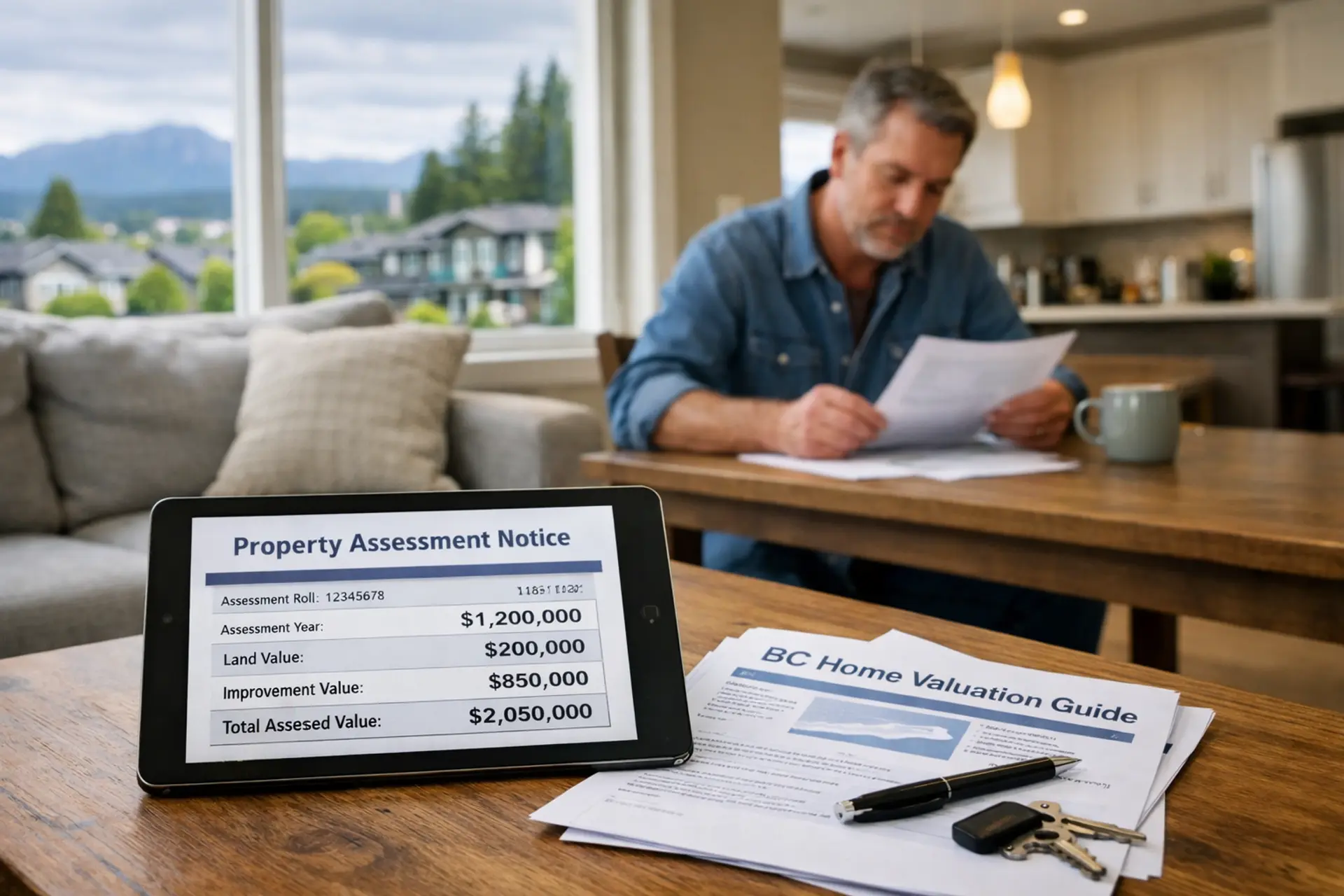
The rate is half of the calculation. The other half is the assessed value, and in BC that value is recent. BC Assessment's 2026 figures reflect market value as of July 1, 2025 and physical condition as of October 31, 2025. BC Assessment told Lower Mainland owners that most 2026 changes would fall between a 10 per cent drop and no change.
A lower assessment does not lower the bill when the levy keeps rising, because council divides a larger budget across a smaller base and the rate goes up. In the City of North Vancouver, the average residential assessment fell from $1,451,726 in 2025 to $1,387,684 in 2026, while the average total property tax bill rose from $4,618 to $4,790 (City of North Vancouver, 2026 Property Tax Info Sheet).
Vancouver shows how much the assessed value matters. The city's 2026 example puts a median single-family home, assessed at $2,093,000, at $7,040 in property taxes before the grant, and a median strata unit assessed at $770,000 at $2,590 (City of Vancouver council report RTS 18298, Appendix B). Its rate sits in the lower half of this list, but its detached owners pay some of the largest bills in the region. Zealty's live listings show the same pattern in prices: the median asking price is $1,350,000 in the City of Vancouver today, against $849,000 in Burnaby.
The total rate covers property value taxes only. Several other charges arrive on the same notice or beside it.
The home owner grant then reduces the bill on a principal residence. For 2026 the full grant applies to homes assessed at $2,075,000 or less, it shrinks by $5 for every $1,000 above that, and the regular grant reaches zero above $2,189,000 (Province of BC, Home Owner Grant). The regular grant in Metro Vancouver is $570 for 2026, the amount Vancouver's own example deducts for a median strata unit. Our BC property tax guide covers how to claim it, due dates and the deferment program.
Before you weigh Surrey property tax against a Burnaby or Vancouver bill, pull the current rate from each city's own page, because BC rates reset every spring. Check the assessed value of any home you are serious about; our BC property assessment guide explains how the value is set and how to appeal it. You can search Metro Vancouver listings on Zealty, or compare prices on the Vancouver, Surrey, Burnaby, Richmond, Coquitlam, North Vancouver, New Westminster and Langley housing market pages.
This article is educational and is not tax or legal advice. Confirm your own situation with the municipality and a tax professional before you act on it.

What BC homeowners pay in annual property tax, how the bill is calculated, the Home Owner Grant you must claim, and what changed for tax deferral in 2026.

Closing costs on a $1M home in BC run $25,000 to $40,000 in cash on top of your down payment. Here's the full 2026 breakdown: PTT, GST, legal, CMHC, and adjustments, with a worked example.
BC Assessment values are set each July 1 and usually come in below market value. Here's how your assessed value is calculated, how it drives property tax, and when it's worth appealing.


